
Right Aspiration
Reflection stared back blankly
And quickly raised a brow.
She smiled slightly, closed her eyes
And then she spoke out loud.
“I have a question posed to you,
My ever-changing friend;
If I believe, and keep my faith,
Will I see where I end?”
Eyes open, stone walled face,
Reflection gave some thought.
“First ask yourself these six words;
What is it that you want?”
When she sought this answer,
Then it’s Truth that she would find.
And in its ways, She felt Its grace
And then came peace of mind.
****************************************************************
I am slowly coming to the conclusion that working with individuals who are dying is not for everyone. Over the past couple of months we have had a number of nursing aids come and go from their positions at Altamount. I think that a couple of them couldn’t take it emotionally, and another one used the opportunity as a stepping stone prior to heading to the states for nursing school in Miami.
Rita Lucas – our latest nursing aid, has been here for a month now. She and her family reside on the Island. She seems to have what it takes to do well – a lot of heart and patience. Her family has been settled on the island for five generations dating back to the end of the sugar plantation/ slavery era. As a medical student (currently on sabbatical), I feel confident to assume that there is fixing to be a sixth generation that will be coming onto “the rock” in no time flat.
Rita is six months pregnant, and she glows when she smiles. She and her husband Edward live down the street from Altamount in the house she grew up in. They are young parents to be, and they sure seem in love. Edward is always over at lunch time bringing her warm comfort food and fresh water; real sweet stuff.
Rita is the youngest of four girls. She is the only one of her sisters that was married. To say that her family is excited is an understatement. Rita had introduced me to her father one day after we bumped into each other in town. Her father is a large and imposing man with an enormous edentulous smile. He was clearly going to be a proud grandfather – and he tells everyone in earshot about it.
Rita and I are about the same age, and we both have aspirations of becoming physicians someday. From what I have witnessed, she has natural compassion, intelligence, and drive in abundance. I would be proud to have her take care of me someday. I think because of our similar age and professional goals, she has confided in me as a peer about her own struggles in this new position.
While commiserating on the prospects of potential provider burnout, she even introduced me to her “personal therapist”. This analyst is actually her favorite local deer – her name is “Wanda”. Apparently she goes by this name as she has no home and “wandas all over the island”. The doe appears to be missing part of her right ear but apparently she is a good listener. I suppose most animals are good that way.
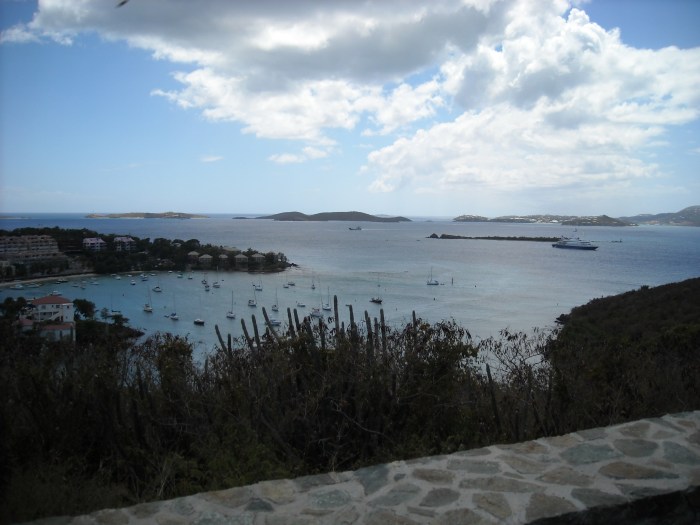
Wanda is actually one of many feral animals living on St. John. It is not uncommon to walk up onto a group of donkeys, cows, chickens, cats, peacocks, or college age men just milling around. Wanda also happens to spend a lot of time at Rita’s house eating the grass and flowers – much to her fathers chagrin.
There is something very special about the awareness of a new life on its way that is disarming to people. I suppose it leads to really awkward moments for women who are pregnant – like when they are touched on the belly by complete stranger in the elevator. In this often surreal environment of a residential hospice, there is something even more unique and wonderful about the awareness.
With the clients, there appears to be some palpable but unspoken joyful hope that is created when they see Rita waddling about. If even for an unconscious moment, they seem to become aware of the cycle of life, death, and rebirth. In that instant they are free of that existential fear that seeps into every other moment of their days.
Rita’s presence really draws them out – or maybe back in to the world to connect with that life force that wanes within themselves. I have heard some of the clients who are mothers themselves talk of there own experiences to Rita. In a few cases when the clients children were present, it was an amazing conversation bridge.
In this unique atmosphere it is customary to talk about death. It is actually encouraged as a necessary part of the process of transition for both client and families alike. It is an infrequent treat to be surprised by the promise and conversation of new life. Rita is by far the most beloved staff member here by the residents and she knows it. Well at least she keeps reminding me of it.
Rita and the clients have also been teaching me how undeniably important it is to respond to patient emotions. I think for her it is easy. She clearly possesses a natural grace. I on the other hand, lack this completely. Although I feel like I am confident, polite, and likable enough, in this environment, it is really all about developing a reflective presence.
As a second year medical student, my previous understanding had been that in the event of a patient spiraling towards death, my inclination should be, “don’t just stand there, do something!” I am beginning to learn it that in the appropriate situation, it can be even more powerful and helpful to “don’t do anything, just stand there…”
I recognize Rita’s skill in listening to the clients – she never interrupts the moments she spends with them to provide some data point or unwarranted explanation. When I watch her, I wonder how many times I have seen patients roll their eyes at physicians rambling on about the myriad of things that could or couldn’t be occurring with their bodies. As if detailing a more extensive differential diagnosis makes them more effective as a healer. It strikes me that sometimes pontificating medical assumptions and diagnostic possibilities are useless to the patients. Sometimes they just need you to be there with them in that moment, to feel safe and well cared for.
Rita has taught me to take my own “emotional temperature”. If I feel it rising, I can use that as a tool to understand what the patient is projecting. Am I feeling anxious, or sad, or desperate – well, maybe the clients are telling me something without words that I should follow up on. In following up, I have realized that coming from a place of curiosity, rather than presumptive understanding is key. I have begun to use the phrases “tell me more about…” or “help me understand…” When assessing the issues that are concerning them.
As I learn more every day, about life, death, and myself, I am struck by the possibilities. These lessons I am learning stretch far beyond developing a skill set to be a better clinician some day. They in fact are making me a better and more engaged person today.
 Destination Hospice